
Why Can't I Find Quality Beats That Fit My Style?
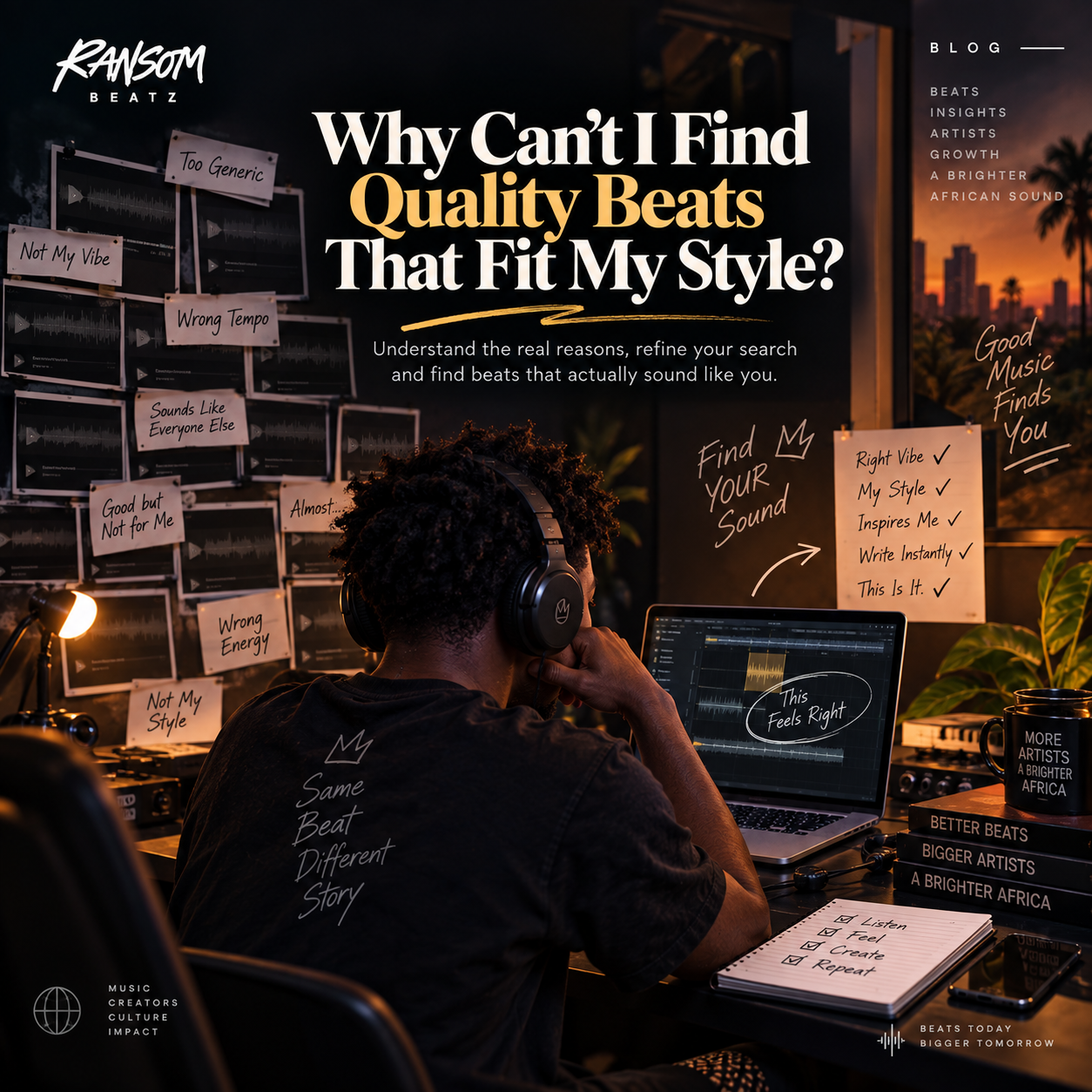
You've probably been there.
You open YouTube.
You search for beats.
You find one that sounds good.
Then another.
Then another.
Three hours later, you've listened to 150 beats and somehow...
You still haven't found the one.
The beats aren't necessarily bad.
Some are actually really good.
They just don't sound like you.
Maybe the drums are right but the melodies aren't.
Maybe the melody is fire but there's no room for your vocals.
Maybe the beat sounds good for someone else but you can't hear yourself making a song on it.
Or maybe you're searching for something so specific that typing another variation of "Afrobeats type beat" isn't going to solve the problem.
So what's actually going on?
The problem might not be the lack of quality beats.
You might just be searching for beats the wrong way.
Let's fix that.
Your "Style" Might Not Be as Specific as You Think
A lot of artists say:
"I know my style. I just can't find beats that sound like me."
But when you ask them what their style actually is, the answer is usually something like:
"I make Afrobeats."
That's a genre.
It's not necessarily your style.
Two artists can both make Afrobeats and sound completely different.
One might prefer:
- Dark melodies
- Heavy drums
- Minimal production
- Low BPM
- Deep bass
Another might prefer:
- Bright guitars
- Fast percussion
- Melodic hooks
- Live-sounding instruments
- More energetic arrangements
Both can call themselves Afrobeats artists.
But they're looking for completely different beats.
So before searching for your next instrumental, you need to understand what actually makes a beat sound like you.
Start With the Songs You Already Love
Here's one of the easiest ways to figure this out.
Take your 5–10 favorite songs.
Don't just listen to them casually.
Study them.
Ask yourself:
What do these songs have in common?
Maybe they all have melodic guitar lines.
Maybe they all have dark piano chords.
Maybe the drums are very minimal.
Maybe you prefer heavy bass.
Maybe you love songs where the artist has a lot of space for vocals.
Maybe you always gravitate toward emotional production.
Write those things down.
You might discover that your taste is much more specific than you thought.
Instead of saying:
"I want an Afrobeats beat."
You can now say:
"I want a mid-tempo Afrobeats beat with dark chords, melodic guitar, heavy percussion and lots of space for vocals."
That's a much better search.
Stop Searching Only by Artist Name
Type beats are useful.
But they can also put you inside a box.
You search:
"Wizkid type beat."
You get a bunch of beats trying to capture a certain sound.
Then you search:
"Burna Boy type beat."
More beats.
Then:
"Rema type beat."
More beats.
Eventually everything starts sounding like variations of the same thing.
Instead, try searching by sound and emotion.
For example:
Dark Afrobeats instrumental
Melodic Afro-fusion beat
Emotional Afrobeats instrumental
Afroswing R&B beat
Amapiano R&B instrumental
Afrobeats guitar instrumental
Afro-fusion trap beat
Minimal Afrobeats beat
You're no longer asking:
"Who does this sound like?"
You're asking:
"What do I want this song to feel like?"
That's a much better place to start.
You Might Be Looking for the Wrong Beat
Here's something artists don't talk about enough.
Sometimes you don't need a beat that sounds exactly like your previous music.
You need a beat that allows you to become a better version of your sound.
There's a difference.
If you only search for beats that sound identical to everything you've already made, you're going to keep making the same song.
Try something slightly outside your normal comfort zone.
If you normally use slow Afrobeats, try something faster.
If you normally use heavy drums, try something more minimal.
If you normally rap, try a melodic beat.
If you normally sing over bright production, try something darker.
You might discover a side of your artistry you didn't know existed.
The Beat Sounds Great — But You Can't Hear Yourself On It
This is one of the biggest reasons artists reject good beats.
You listen to the instrumental and think:
"This is fire."
Then you try to write.
Nothing.
You try again.
Nothing.
You freestyle.
It sounds forced.
So you move on.
That doesn't necessarily mean the beat is bad.
It might simply mean the beat isn't giving your voice enough space.
Some beats are designed to be the star.
Others are designed to support the artist.
If you're a vocalist, you usually want enough room for:
- Your main melody
- Your lyrics
- Harmonies
- Ad-libs
- Vocal effects
- Dynamic changes
A beat can sound incredible by itself and still be terrible for your particular voice.
Don't judge a beat only by how good it sounds in your headphones.
Judge it by what you can create on top of it.
Try Humming Before Writing Lyrics
Here's a simple trick.
Don't immediately start writing lyrics.
Play the beat.
And hum.
No words.
Just melodies.
Try different rhythms.
Try different vocal patterns.
Record yourself on your phone.
You might discover that your voice naturally finds a melody on a beat before your brain knows what the lyrics should be.
Once you find the melody, the lyrics often become much easier.
This is especially useful when you're searching through dozens of beats.
Instead of asking:
"Do I like this beat?"
Ask:
"Can I hear myself singing on this?"
That's a much better test.
Your Vocal Range Matters More Than You Think
A beat can be amazing and still be wrong for your voice.
Maybe the melody sits too high.
Maybe the bass is fighting your lower register.
Maybe the song's natural key makes your hook uncomfortable.
Don't force it.
If you're constantly straining to reach notes, you're going to spend the entire recording fighting the instrumental.
If the license and production allow it, you may be able to transpose the beat.
But ideally, find production that naturally sits inside your comfortable vocal range.
The right beat should make you want to sing.
Not make you worry about whether you can hit the next note.
Stop Listening to Beats Like a Listener
This is a huge mindset shift.
Most people listen to beats like fans.
Artists need to listen like songwriters.
A listener might think:
"This beat is fire."
An artist should think:
"Where does my hook go?"
"Where do I breathe?"
"Where does the verse start?"
"Can I create a melody here?"
"Where would I put the ad-libs?"
"What happens when the chorus comes back?"
"Is there enough space for my voice?"
The second you start listening this way, your b